

In the last week, meandering around England with some friends, I went to several places that will be on my England tours in April and May, so I thought I would tell you all about the trip.
First, in London, I took a quick look around the National Portrait Gallery, to see if things were more or less where I expected them to be. Mostly, the answer was yes, but of course there were also some new things, including a display of 17th century cartoons of my favorite English scandal—the one in which the wife of King James I’s ex-boyfriend Robert Carr (a woman so sleazy that she got her first marriage annulled by falsely accusing her husband of being impotent) was found to have poisoned Carr’s older, wiser buddy who tried to convince him not to marry her.
 But most of this trip was outside London, visiting “Stately Homes” (great country houses) with LGBT+ stories. The first was Knole, only ½ hour train ride south of London in Kent, and the largest of all of England’s Stately Homes. It is called the calendar house, because (supposedly—after all, who can count them?) it has 365 rooms, 52 staircases, and 7 courtyards. It is (still) the seat of the Sackville-West family, relatives of the Tudors, and it has a lot of history, LGBT+ and not: it was a palace of Cardinal Wolsey’s that he was forced to give Henry VIII, who used it among other things to stash the future Queen (Bloody) Mary I while he was divorcing her mother. And it is generally fabulous, full of astonishing royal-level furniture and a great portrait collection, including an entire room of Joshua Reynolds paintings. Its gay story revolves around Viriginia Woolf’s girlfriend Vita Sackville-West, a very popular author at the time in the 1920s and 1930s, and of course the heiress—or *not* the heiress, because the estate, like many great estates, always goes in its entirety to the eldest *male* heir, so her cousin Eddy got it instead. Vita loved her family home, and it drove her crazy that she couldn’t inherit it, and it is probably to console her that Virginia wrote the novel Orlando, about or at least for Vita (transformed into a young male Elizabethan aristocrat who lives through many centuries and in the 19th century transforms into a woman, i.e. Vita is her ancestors and becomes herself). Don’t feel too bad for Vita, though: she and her husband bought a nearby ruined castle, Sissinghurst (where a number of her ancestors had lived) and transformed it into a showpiece, particularly its beautiful and very influential gardens, which they treated as a series of separate, private rooms, such as the famous white garden, which is planted completely with white and off-white flowers. People often say that they arranged everything as private rooms, because they lived such separate lives—she with her lesbian relationships, he with his gay ones—but they could come together when they wanted to and live as a married couple with their children. In fact, although they were very hoity-toity aristocrats (and huge snobs) their lives were just as sexually and romantically experimental as those of their arty friends in the Bloomsbury group.
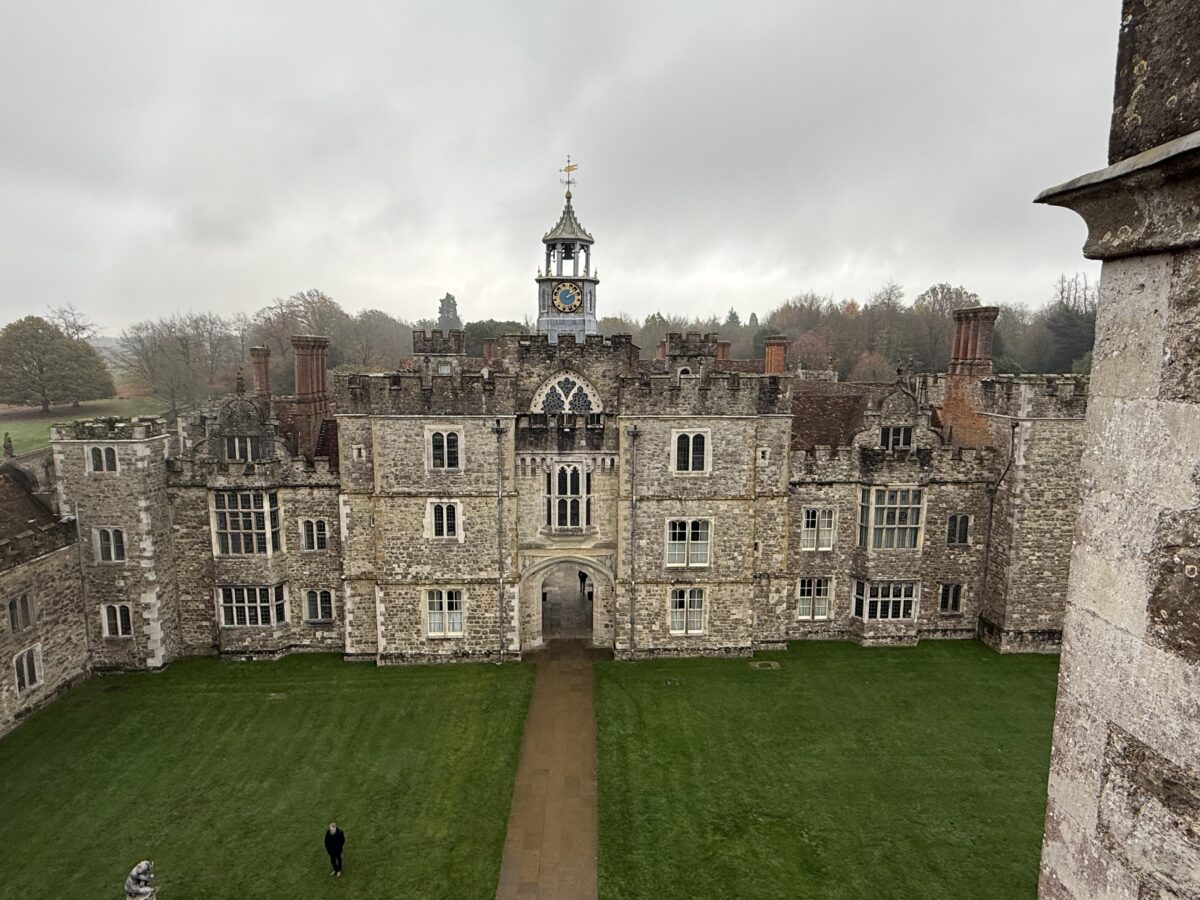 Anyway, nothing of Vita remains at Knole, but there is a lot about Eddy—who gets a lot of bad press, because Vita resented him, but was really an interesting guy, a music critic and writer, who was also gay and had a lot of interesting affairs (for instance with Bloomsbury painter Duncan Grant) and friendships. He just inherited Knole and felt it was a huge burden: ultimately it is he who gave the public part of the palace to the National Trust and thereby probably assured its preservation, since love it or no, no private person could afford the upkeep on a place this huge!
Anyway, we didn’t go to Sissinghurst this time, because November is not a good time for gardens (which will instead be especially gorgeous in April and May). Nor did we stop to see the Bloomsbury commune (more or less) at Charleston Farmhouse or the Woolfs’ Monk’s House (where Viriginia wrote all of her most famous novel, e.g. Mrs Dalloway)—both of which we will visit on the tour—but instead we went on to Bath.
If you don’t know Bath, I should start by saying that Bath is gorgeous. It is a beautifully preserved city from the late 18th and early 19th century, when it grew up as a fashionable resort around the also quite well-preserved ancient Roman mineral baths. It is right out of a Jane Austen novel, and in fact, she lived there several times during her life and wrote about it a lot, especially in Persuasion and Northanger Abbey (and btw, Mary Shelley also wrote Frankenstein in Bath). And we spent a lot of time searching out the Jane Austen references and also visiting the Baths, which are now a very interesting museum about ancient Roman Bath.
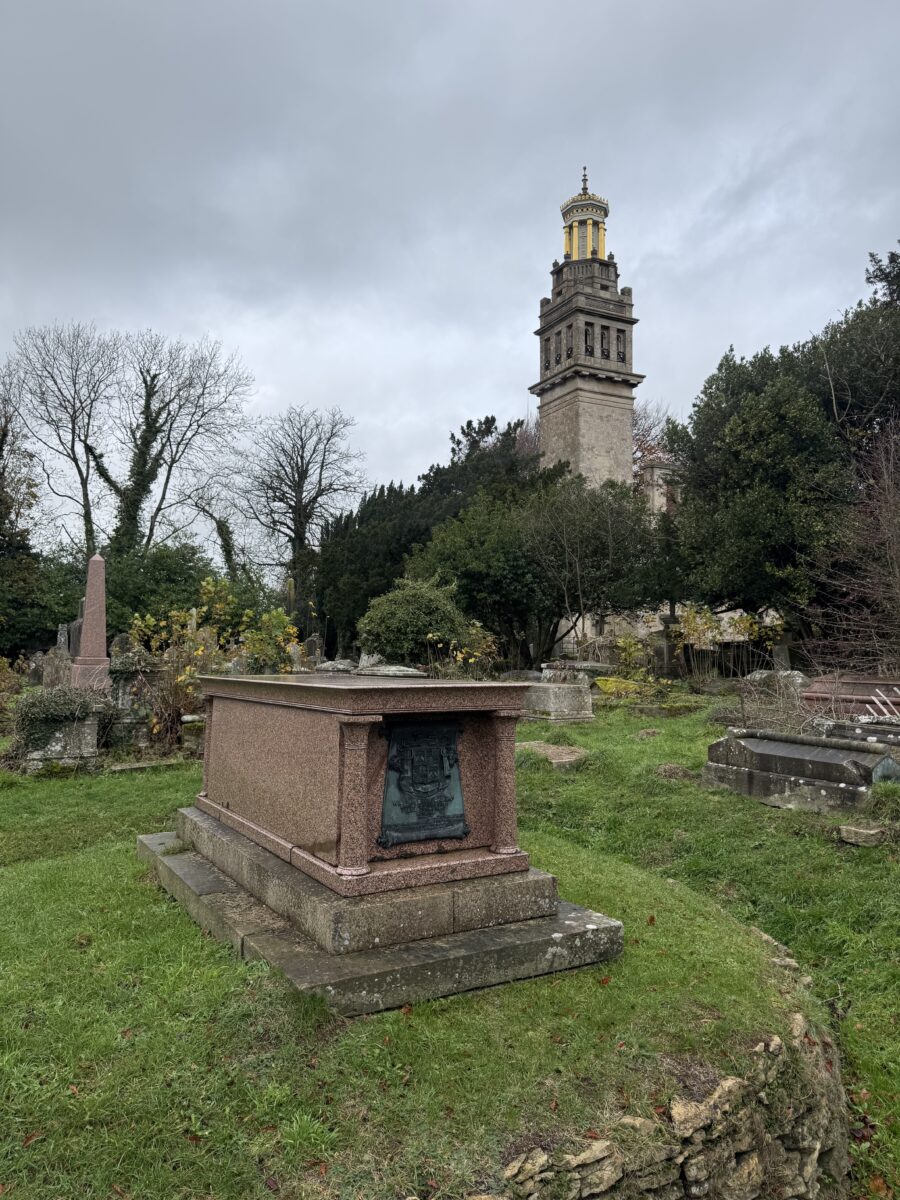 But we were mainly there to visit a less famous monument, William Beckford’s Tower, just outside the town. Who was William Beckford? He was first of all the wealthiest commoner (non-aristocrat) in 18th century England; his father was Lord Mayor of London. He was also a man of astonishing talents: he wrote the first Gothic novel, (which he wrote in French, because that’s how he rolled); he designed the first great neogothic building in England, his vast country house, Fonthill Abbey; and he was a piano student of Mozart’s. One might say that his wealth and his talents came together in his art collecting. He was the most prominent art collector in England in his time, and many works from his collections are in major museums today.
But then….there was a big gay scandal. It’s a hard one to write about, because we only know it from letters, but it seems that Beckford was caught in a bedroom of the Chief Justice’s house (oops!) with the justice’s nephew—the future Earl of Devon, William “Kitty” Courtenay—whom he was perhaps horse-whipping. Was this s&m? We don’t know, but it seems that Beckford had found out that Kitty, who was 8 years younger than Beckford but also clearly gay, had written a love letter to someone else. We’re not sure, but in any case, high society shunned Beckford from that moment on. At first he lived in self-imposed exile in Portugal, but eventually he returned to England, and after selling Fonthill Abbey, he built himself this tower just outside Bath, in an estate that is now a historic cemetery. But the tower is still there, and there are exhibits about Beckford, with some of his original furniture etc.
Frankly, the museum seems to focus on the fact that Beckford’s wealth derived from sugar plantations, i.e. that he was a slave-owner, and the fact that Courtenay was only 11 when they met, so he is what today we would call a pedophile. But there is no evidence that Beckford and Courtenay were lovers as soon as they met. When the scandal took place, Courtenay was 16, which is of course too young by our standards today, but not by 18th century standards. Indeed, I know of no period source which treats Courtenay’s age as a factor in the scandal. In short, Beckford being a slave-owner and having a teenage lover are things that we dislike about the 18th century, rather than about Beckford as an individual, so it seems to me kind of a waste to focus on them when discussing him, because he was instead an exceptional person in other ways. In fact, he is to my knowledge one of the first people who expresses a group identity as what we would call a gay man. There are of course many people in history who had same-sex relations and who expressed same-sex desire. In Shakespeare’s Sonnets, for instance, he addresses a “fair youth” (or perhaps a number of fair youths) with whom he is clearly in love: in Sonnet 20, for instance, he calls him “the master mistress of my passion” (speaking of s&m!). But Shakespeare never for a second indicates that this makes him a particular kind of person or gives him something in common with other man who love males. This idea—an early version of today’s gay identity—although it may of course have existed earlier, is never expressed. But Beckford seems to have it. He kept large scrapbooks, and among many other things, he kept articles about police raids on London’s “molly houses” (an early version of gay bars), and on one letter he comments sympathetically about the men who were arrested. The word/concept “homosexual” didn’t appear until the 1860s, but of course there was a long history behind the creation of that word/concept, and Beckford is an important gay ancestor.
Anyway, then (after going back to London for a night) we went in a whole different direction—north, to York, like Bath, another one of England’s charming, smaller cities. York is a famous industrial city (among other things for tea and chocolate manufacturing) and a great rail center, but it is a well-preserved historic city. There is a lot of 18th century here as well, but the principal note is medieval. The city centers on the York Minster, possibly the best-preserved Gothic cathedral anywhere (which also has a wonderful museum, in the crypt, about York’s Roman and medieval history). But there are also a number of other medieval churches, including Holy Trinity, a lovely 13th/14th century church—which is where the first gay marriage in British history took place, in 1834!
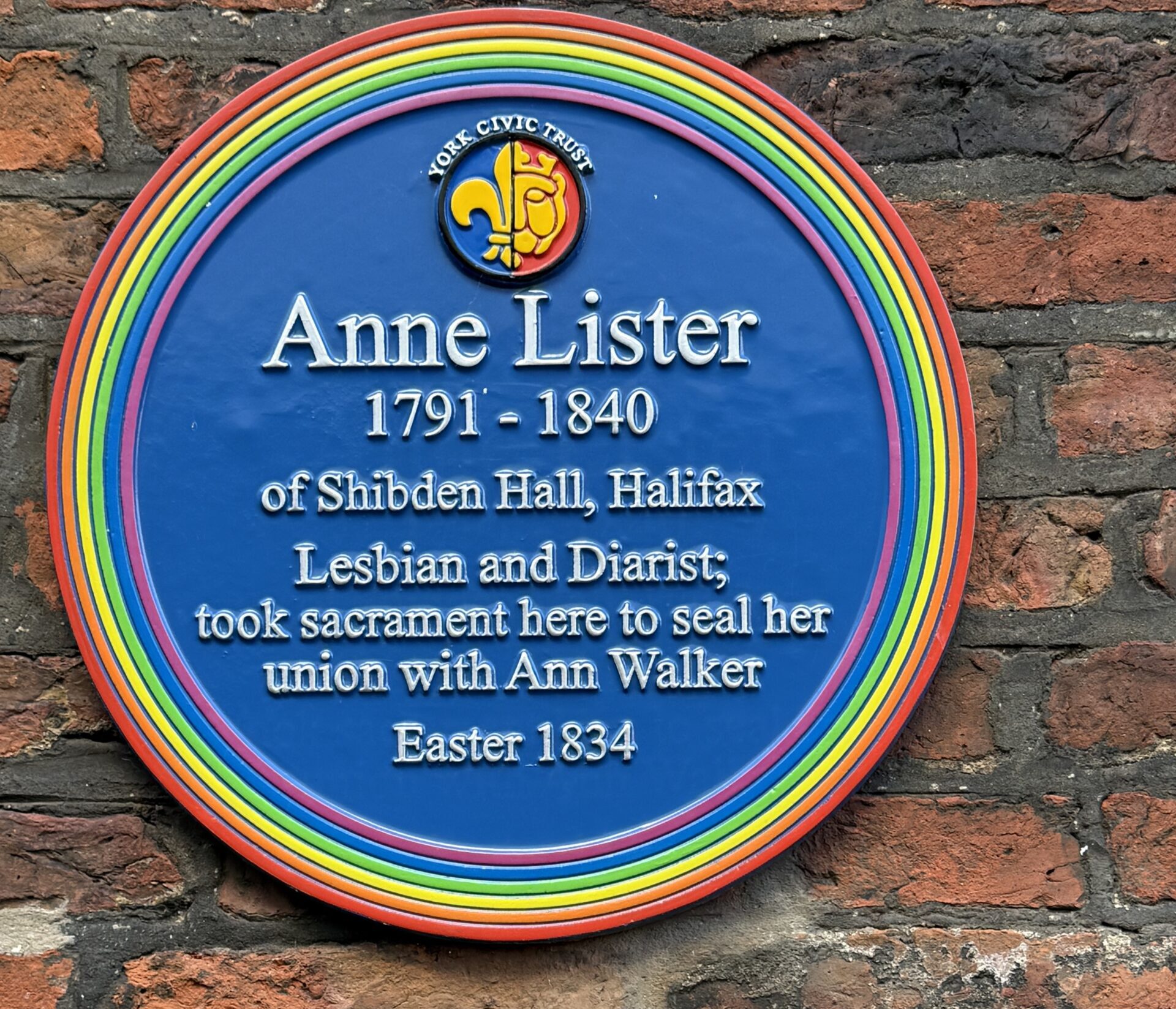
Some of you will know the story of Anne Lister, from the 2019 TV series about her, Gentleman Jack. Anne Lister was a wealthy woman from Halifax (about an hour away from York) in the early 19th century who did not conform to the gender expectations of her time. She did not marry (a man, anyway); she did not dress in elegant clothes or have elaborate hairstyles; she worked hard at her education and at managing her estate, on which she opened coal mines (the new, cool thing of that period, along with railways, in which she invested); she traveled Byronically—indeed, she died as she was exploring the Caucasus mountain range. And as we now know, she was also a lesbian. Indeed, some historians call her the first lesbian in history. She was not of course the first woman who loved other women! (hello, Sappho!—also undoubtedly not the first but in any case 2500 years earlier). But she is the first woman in whose own voice we hear that she desired *only* women—because Anne Lister was a diarist. She wrote between 4 and 5 million words of diary, or perhaps more—over 4 million words have survived—and when scholars decided to study her diaries in the 1970s, and decoded the sections (about 1/6) written in code, they found quotes like the following, which she wrote when she turned down one of her male suitors, “I love and only love the fairer sex, and thus, beloved by them in turn, my heart revolts from any love but theirs.”
On the tours, we will visit Lister’s house (also a Stately Home) in Halifax, but when we got to York this time, it had just closed for the winter. But we could visit Holy Trinity. And then we went to see a great monument of gay TV. As some of you may know, the author Evelyn Waugh, when he was at Oxford, had a crush on and friendship with, possibly an affair with, a young aristocrat called Hugh Lygon. Lygon took him home to visit his family and his family seat during the holidays, and Waugh fell in love with the whole family. He transformed this experience into the novel Brideshead Revisited, which in 1981 became a wonderful TV series, starring Jeremy Irons as Charles Ryder (Waugh in real life) and Anthony Andrews as Sebastian Flyte (Hugh in real life—though mixed with at least one other boyfriend of Waugh’s college years). The real story took place at the Lygon family seat, Madresfield, which we will see on the tour—but it is too hard (impossible?) to get to by train. On the other hand, from York, you can take a bus to see England’s 2nd largest Stately Home, Castle Howard, where the Granada TV version was filmed. So that is where we got to see Jeremy Irons and Anthony Andrews naked together—from the back….
Anyway, it was a great trip, which ended when I had to go back to London to meet with the producers of Stephen Fry and my LGBT+ history TV series and to be interviewed about LGBT+ history by the Observer (let’s hope they print the article!). But I thought you would enjoy hearing about the trip, and it would give you an idea of what you might see on my tours of England (and perhaps an idea of what my tours are like in general).